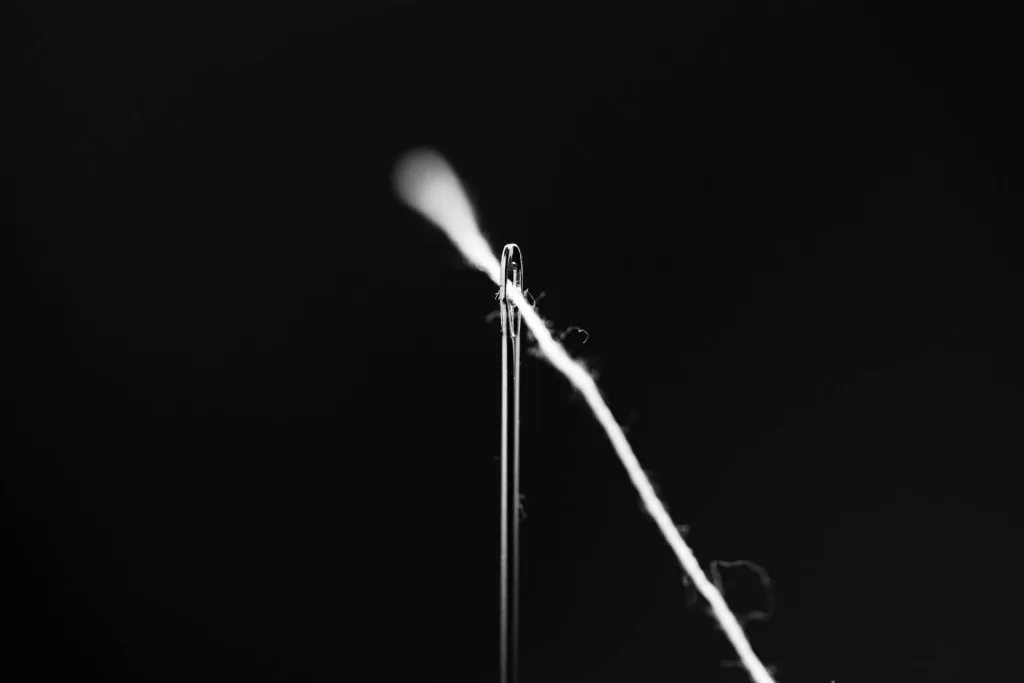
Sewing refers to the process of joining fabric using a needle and thread. It can be done by hand or with a sewing machine. Before the spread of Western influence in Korea during the late 19th century, most sewing was done by hand. Over time, various unique techniques developed, with distinct methods compared to neighboring countries.
Below are some of the basic hand sewing techniques.
(1) Running Stitch
This is the most commonly used basic stitch. It involves passing the needle in and out of the fabric at regular intervals. The stitches should be even, and both sides should maintain consistent spacing. It is widely used for general seams and layered clothing.
(2) Backstitch
This method is used to strengthen seams. After making a forward stitch, the needle is inserted backward into the previous stitch line, creating a more durable seam. Sewing machines use a similar principle.
(3) Half Backstitch
This stitch is stronger than a running stitch but less dense than a full backstitch. It balances speed and durability.
(4) Blind Stitch
There are two main variations. One method keeps the thread slightly visible at an angle, while the other hides it almost completely by inserting the needle diagonally. This is often used when a clean outer appearance is important.
(5) Slip Stitch
Used for finishing edges such as openings. The goal is to keep the stitches barely visible on both sides. It is commonly applied when hemming or closing seams neatly.
(6) Decorative Stitch (Topstitching)
This technique is used both for decoration and reinforcement. Depending on the number of stitch lines, it can vary in appearance. The spacing between stitches can also be adjusted for different effects.
(7) Basting Stitch
This stitch is used to temporarily hold multiple layers of fabric in place. The stitches are longer and more spaced out, making them easy to remove after final sewing.
(8) Fine Stitch
This method is used for delicate fabrics such as silk. The stitches are very small and close together, helping maintain a clean look without visible thread lines.
(9) Cross Stitch
Often used for both joining and decorative purposes. The thread crosses in an “X” pattern, creating a strong and visually distinct finish.
(10) Herringbone Stitch
This stitch is commonly used for decoration or for securing thick fabric edges. The thread moves in a zigzag pattern, creating a crossed structure that adds both strength and flexibility.
(11) Whip Stitch
Used to prevent edges from fraying or coming loose. The needle wraps around the edge of the fabric at regular intervals, holding layers together securely.
(12) Machine Seams
There are several types of seams used in machine sewing, mainly for durability and finishing.
- Plain Seam (Tongsol)
Used for fabrics that tend to fray easily. The seam allowance is folded inward to keep the edges clean. - Open Seam (Garumsol)
The seam allowance is pressed open after stitching. It is commonly used for thicker fabrics, though extra care is needed to prevent fraying. - French Seam (Gopsol)
This method encloses the raw edges by sewing twice, resulting in a clean and durable finish. It is often used for lightweight fabrics. - Flat-Felled Seam (Ssamsol)
One side of the seam allowance is folded over the other and stitched down, creating a strong seam with a neat appearance. From the inside, two stitch lines are visible, while only one appears on the outside.